
Nov 11, 2026 · 5 min read· Summarize in ChatGPT
Groundwater across Maryland, Virginia, and West Virginia often contains sand, silt, and dissolved minerals such as iron and manganese. For homes on private wells, your well pump will pull these impurities into your system, where they can accumulate in your water heater over time.
Sediment settles at the bottom of the tank, and dissolved minerals can drop out as the water heats. That buildup affects performance, lifespan, and whether a water heater repair makes sense when something starts to go wrong.
Where the Sediment Comes From
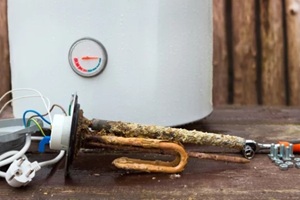
The type and amount of sediment your well produces depend on the aquifer’s geology. Wells that tap into limestone or sandstone formations tend to produce harder water, meaning higher levels of dissolved calcium and magnesium. Those minerals can form a hard coating on heating elements and the inside walls of the tank as the water is heated.
Iron and manganese, which are common throughout the region’s groundwater, cause a different problem. They stay dissolved in cold water but can precipitate out and settle as solid material at the bottom of the tank as the temperature rises.
Some wells also carry visible sand or silt year-round, which speeds up buildup even more. But even wells with relatively clear water can contribute enough dissolved minerals to affect the tank over several years.
Symptoms That Usually Point To Repair or Maintenance
Homes on sediment-heavy well water will eventually see signs that their water heater is struggling to meet demand. Some of these signs can be addressed through routine maintenance and relatively simple repairs.
A rumbling or popping sound during heating cycles typically comes from water trapped within a sediment layer at the bottom of the tank. As the burner or lower element heats the tank floor, small pockets of water in the sediment turn to steam and push through, creating that popping sound. A thorough flush to clear the buildup, followed by a professional check of the other components, can usually resolve it.
A worn anode rod is another common service item. The anode rod is a metal rod inside the tank that corrodes more easily than the tank’s interior lining, so the water reacts with the rod first instead of attacking the lining itself. On well water with elevated mineral content, that rod can deplete faster than the typical three-to-five-year window. Replacing it is routine maintenance, and it can add years to a tank that’s otherwise in good condition.
Slow recovery, where the tank takes noticeably longer to reheat after heavy use, often points to a failed heating element or a thermostat that’s no longer reading accurately. Both are replaceable components, and neither means the tank needs to go.
Symptoms That Point Toward Replacement
Moisture or visible rust at the base of the tank generally means the interior lining has corroded through. Once the steel beneath that lining is exposed, the damage is structural, will only worsen over time, and doesn’t have a simple fix.
If your tank water heater is approaching or past its typical eight- to 12-year service life and is showing problems, replacement may make more sense than repeated repairs. Sediment-heavy well water can shorten that service life, and frequent repairs can add up quickly as a unit ages.”
Repair or Replace at a Glance
The decision to repair or replace typically comes down to whether the tank itself is still structurally sound.
| What You’re Seeing | Likely Direction |
| Rumbling during heating | Regular Professional Flushing |
| Element or thermostat failure | Repair |
| Worn anode rod | Routine Maintenance |
| Rust or moisture at the tank base | Replace |
| Discolored hot water after flushing | Replace |
Multiple symptoms from the replacement column together indicate that the tank may be nearing the end of its usable life.
Why Sediment Shortens Tank Life
A layer of sediment between the heat source and the water forces the system to work harder. In a gas water heater, the burner has to heat through a mineral layer before the water above it warms. That concentrated heat on the tank floor can damage the glass lining over time. Once the lining cracks, the exposed steel beneath it begins to corrode. In an electric unit, the lower element can become partially buried, causing it to overheat and burn out sooner.
Professional flushing on a regular schedule keeps sediment from building up to the point where it causes damage. Most manufacturers recommend flushing every six to 12 months for homes on hard or mineral-heavy well water.
If you repair or replace your water heater, the sediment that caused the problem will still be in your system. A sediment filter or treatment system installed ahead of the water heater reduces how much particulate and dissolved mineral content reaches the tank. For homes where iron or manganese is the primary concern, a system designed for those minerals can address the issue before heated water has a chance to deposit them.
Protecting Whatever Unit You Keep

Tri-County Pump Service, Inc. offers a free in-home water analysis that covers hardness, iron, and pH levels. Lab-based testing is also available for additional concerns (at an additional cost). That analysis gives you a clearer picture of what’s in your well water and how filtration and treatment can extend the life of your next unit.
If your water heater is giving you trouble, call Tri-County Pumps at (301) 882-2698 or schedule an appointment online for a technician to diagnose your system and evaluate your water. A water heater repair goes further when the water feeding into the tank is part of the conversation. Keep It Flowing®.