
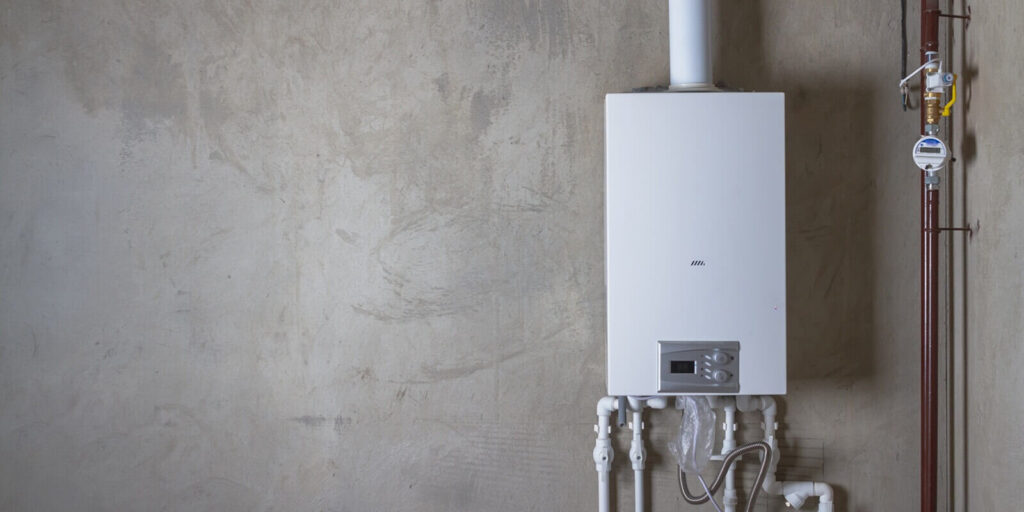
Sep 22, 2026 · 6 min read· Summarize in ChatGPT
Your storage tank water heater did its job for years, but you’ve started looking into a tankless water heater as a replacement. Hot water on demand, no heat loss from a unit holding unused hot water, and a smaller footprint all sound like an upgrade. However, you’ve heard that in an older home, the conversion involves more than removing one unit and hanging another on the wall.
Many homes across Maryland, Virginia, and West Virginia were built around the slower, steadier demand of a conventional tank heater. A tankless unit heats water on demand as it passes through, which requires a much higher instantaneous energy input. That difference affects gas supply, venting, electrical capacity, and water treatment for homes on a private well.
Why the Conversion Is More Than a Swap
A storage tank water heater draws energy at a modest, predictable rate. A gas tank typically uses around 36,000 to 40,000 BTU per hour, firing in short cycles and shutting off once the stored water reaches temperature. An electric tank draws around 4,500 to 5,500 watts on a single dedicated circuit. Either way, the home’s infrastructure was sized for that level of demand.
A tankless unit heats water in real time, which means a much higher instantaneous draw. A whole-house gas tankless unit may require 150,000 to 199,000 BTU per hour. A whole-house electric tankless possibly draws 18,000 to 36,000 watts, often requiring multiple dedicated 40- or 50-amp circuits and, in many older homes, a panel upgrade to 200-amp service.
That gap is what makes the conversion a project rather than a straightforward replacement. Gas tankless units put new demands on the gas supply line, venting, and condensate drainage. Electric tankless units put demands on the electrical panel and wiring instead. In both cases, the home must be ready for the unit before it goes in.
Gas Supply and Line Sizing
The gas line running to your current tank heater was sized for the appliance that was there when the house was built. In many older homes, that’s a half-inch pipe carrying enough volume for a 36,000 to 40,000-BTU appliance.
A tankless unit drawing three to four times that load can require a three-quarter-inch or even a one-inch line, depending on the total run length and how many other gas appliances share the supply.
The furnace, the range, and the dryer all pull from the same source, and total household demand factors into the sizing calculation. In some cases, it may require an upgrade to the gas meter. This is common in homes built before the mid-1990s, and it’s one reason a site assessment matters before ordering the unit.
Venting and Placement
Gas storage tank water heaters typically vent through a metal flue pipe that connects to a masonry chimney or a B-vent running through the roof. These are natural-draft systems where the hot exhaust rises on its own.
Tankless units use powered exhaust fans that push combustion gases out through sealed, dedicated vent piping. They can’t share the existing chimney flue because venting pressure and temperature requirements differ. Most installations require a new vent run through an exterior wall or up through the roof, using stainless steel or, for higher-efficiency condensing models, PVC or CPVC piping.
Where the unit goes in the house is often driven more by vent routing and clearance requirements than by where the old tank sat. Condensing models produce acidic condensate that needs a drain path, and some local codes require a neutralizing kit on that drain line to protect the plumbing.
Water Quality on Well Systems
If your home is on a private well, water chemistry becomes part of the conversation. Hardness and iron can affect a tankless heat exchanger differently than they affect a storage tank.
In a storage tank, minerals settle to the bottom over time and sediment accumulates gradually across a large volume. In a tankless unit, water passes through narrow channels in the heat exchanger at high temperatures, and dissolved minerals tend to deposit on those surfaces more quickly. Scale buildup in those channels may reduce flow, lower efficiency, and eventually trigger error codes that shut the unit down.
Groundwater hardness across Maryland, Virginia, and West Virginia varies with the underlying geology. Wells tapping limestone formations often produce hard to very hard water, while wells in crystalline rock may test softer. Iron is also common in well water across the region, and even low concentrations can leave deposits in the heat exchanger over time.
Tri-County Pump Service, Inc. offers a free in-home water analysis that covers hardness, iron, and pH. If the results suggest treatment would help, a water softener or iron filter can be installed alongside the unit to protect the heat exchanger. Lab-based testing for other concerns, such as bacteria or sulfur, is available at additional cost.
What the Project Usually Includes
A properly planned tankless conversion starts with a load calculation to size the unit against how many fixtures the household actually runs at the same time. Running a shower, a dishwasher, and a washing machine simultaneously requires a different unit than running one fixture at a time.
From there, the gas, venting, electrical, and water treatment work can be coordinated into a single scope of work rather than several separate visits from different contractors. Removal and disposal of the old tank, along with any county-required permit work, are typically part of the project.
Working with a company that handles both plumbing and water treatment lets you assess the full scope of the job at once, rather than finding a hardness or iron problem after the unit is already installed.
Pressure, Flow, and Realistic Expectations
A tankless water heater delivers continuous hot water, but only at whatever flow rate the system can provide. In homes on a conventional well pump, that flow has limits, and the well system can only run a certain number of fixtures at a time. If household demand exceeds that capacity, the tankless unit may not perform as you’d expect.
For wells with sufficient yield and storage, you can install a constant-pressure system that varies pump speed to keep pressure steady, no matter how many fixtures are running. For other systems, a booster pump can address the flow limitation instead.
If you’re considering a tankless water heater for an older home, have the gas, venting, electrical panel, and water quality assessed together before you commit to a unit. Tri-County Pump Service, Inc. has been helping homeowners across Maryland, Virginia, and West Virginia with their water systems since 1991, and our technicians are trained to look at the whole picture. Call Tri-County Pumps at (301) 882-2776 or reach out to us online. Let’s Keep It Flowing®.