
Mar 2, 2026 · 6 min read· Summarize in ChatGPT

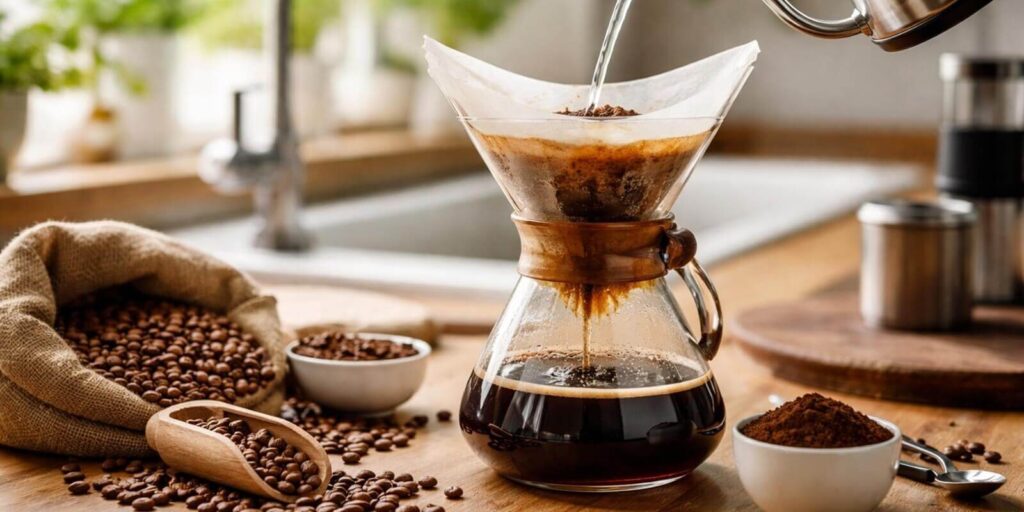
If your coffee tastes flat, bitter, or oddly chemical at home, the problem often has nothing to do with the beans or the brewer.
Coffee is mostly water, and even small issues in your tap water can be amplified during brewing.
That’s why the same roast that tastes balanced at your favorite café can fall apart in your own kitchen.
| In This Article: Today’s article breaks down how water quality shapes coffee flavor and why consistency matters. You’ll learn which water characteristics influence taste, why café coffee stays predictable cup after cup, and how homeowners can improve results through smart testing and solutions for water treatment in Maryland. |
Why Coffee Flavor Falls Apart When Water Quality Is Ignored at Home
Since coffee primarily consists of water, any contaminants present in your tap will be evident in the cup upon pouring.
Chlorine, sulfur odors, iron, or excess minerals do not fade into the background once the water heats up. Heat functions almost as a volume knob, highlighting subtle flavors and potentially dominating unpleasant ones.
Cafes rarely leave this to chance, with many actively managing water chemistry so flavor stays consistent, and equipment stays clean. At home, water quality varies widely across Maryland, with sharp contrasts between treated city systems and water from privately owned wells.
That variation explains why one-size-fits-all filters rarely deliver café-style results and why strategies for water treatment in Maryland work best when they start with testing instead of guesswork.
What Cafe-Level Water Actually Means in Measurable Terms
Coffee professionals rely on defined ranges for water chemistry rather than opinions. A widely referenced framework from the Specialty Coffee Association (SCA) outlines brewing targets that support balanced extraction and protect equipment.
The Numbers Behind Balanced Brewing
| Water Parameter | General Target Range | Why It Matters for Coffee |
| Total Dissolved Solids | About 150 mg/L, acceptable 75 to 250 | Influences overall strength and mouthfeel |
| Hardness | Moderate mineral content | Helps extract flavor compounds |
| Alkalinity | Around 40 mg/L as CaCO₃ | Controls perceived brightness |
| pH | Near neutral | Supports clean taste and stable plumbing |
| Chlorine | As close to zero as possible | Prevents chemical and medicinal notes |
For espresso machines and hot water boilers, the desired taste targets can conflict with the risk of scale buildup.
Research tied to SCA guidance shows that water pushing hardness or alkalinity too high can shorten equipment life once heat is involved. That’s why cafes often operate in a narrow zone that balances flavor with maintenance concerns.
The Chemistry That Explains Why Your Coffee Tastes Thin, Flat, or Harsh
Water chemistry affects coffee extraction at a molecular level. Understanding a few fundamentals helps explain common homeowner complaints.
Hardness Changes Extraction and Texture
Hardness is primarily due to calcium and magnesium. These minerals interact with coffee compounds during brewing.
Peer-reviewed research published in the Journal of Agricultural and Food Chemistry shows magnesium ions, in particular, can increase the extraction of certain flavor-active molecules.
Too little hardness often produces coffee that tastes sharp or hollow. Excess hardness can mute clarity and leave behind chalky or muddy notes.
Hard water also creates scale when heated; the United States Geological Survey documents how calcium carbonate deposits form inside kettles, coffee makers, and water heaters.
Alkalinity Controls Perceived Brightness
Alkalinity reflects how well water buffers acids, largely due to bicarbonate. Coffee contains natural acids that contribute to brightness and liveliness.
High alkalinity neutralizes acids, resulting in a flatter flavor. Very low alkalinity can swing the other way, producing aggressively acidic coffee and raising corrosion concerns in hot systems.
Chlorine and Chloramine Turn Heat Into a Megaphone
Municipal systems commonly disinfect water with chlorine or chloramine. The Centers for Disease Control and Prevention notes these disinfectants can affect taste and odor even at low levels; hot beverages amplify that effect.
In coffee, chlorine can lead to swimming-pool aromas or harsh medicinal notes. Some compounds formed during brewing have extremely low taste thresholds, which explains why a cup can taste wrong even when the tap water seems fine cold.
Why Well Water Can Ruin Coffee Fast Without the Right Treatment
Private wells reflect local geology rather than centralized treatment. Regulatory agencies in Maryland stress the importance of routine testing because water chemistry can shift over time.
Common Well Water Issues That Show Up in the Cup
Hydrogen sulfide creates a rotten egg odor that coffee cannot brew past, while iron and manganese introduce metallic or bitter notes and leave stains. Acidic water can taste sharp and accelerate corrosion in plumbing and appliances.
Maryland’s Geology Makes Blanket Solutions Fail
The Maryland Geological Survey and University of Maryland Extension describe how groundwater chemistry shifts across the state.
Piedmont groundwater is often slightly acidic and low in dissolved solids, which can produce a thin-tasting coffee and increase corrosion concerns. Other areas have to deal with harder water and scale.
That diversity explains why planning for effective water treatment in Maryland starts with analysis rather than a single filter recommendation.
Practical Treatment Approaches That Match Real Water Problems
A distinct disinfectant taste is often the most immediate and recognizable issue in municipal water supplies.
Filters certified under NSF standards for chlorine reduction can improve flavor, though chloramine removal requires specific carbon media and adequate contact time. Once the chemical taste is addressed, mineral balance is usually the reason coffee still falls short of café-quality standards.
The treatment of well water focuses on the contaminant that takes away the taste. Low levels of hydrogen sulfide may respond to activated carbon; higher levels often require oxidation followed by filtration.
When iron and manganese are present, effective treatment depends on equipment designed for metal control instead of taste correction alone. Hardness that leaves white crust in kettles signals scale formation, which is directly related to heated hard water.
Many cafes solve variability with reverse osmosis paired with controlled remineralization. RO acts as a reset, stripping unwanted compounds, and then minerals are added back in precise amounts to support extraction and protect equipment.
Better Coffee Starts With Water You Can Rely On at Every Tap

The difference between average and excellent home-brewed coffee usually starts with the quality of the water you’re using.
Even the best available beans can become unsatisfactory when minerals, acidity, or unwanted tastes are out of balance. Testing and treating water to support flavor can make a noticeable difference, both in your cup and in how your equipment performs over time.
At Tri-County Pump Service, we’ve helped homeowners improve their water since 1991. As a family-owned company serving Maryland, Virginia, and West Virginia, we look at the full picture, from well systems and water treatment to plumbing and septic services.
To enhance your coffee and water quality, book your service online, give us a call at (301) 882-2698, or reach out to us through our online contact form.