
Sep 29, 2026 · 5 min read· Summarize in ChatGPT

If a water test came back positive for coliform bacteria, rest assured you have several good treatment options. But while chlorination can leave a chemical odor in your water and particulate filters may let smaller organisms pass through, UV water treatment systems deactivate pathogens without otherwise affecting the water.
Before you spend money on a system, you’ll want to know what’s actually happening inside that chamber, what UV light water treatment covers, what it leaves untouched, and how it stacks up against chlorination and particulate filtration.
| In this article: UV light water treatment uses light instead of chemicals to stop bacteria and other organisms from reproducing in your water. We cover how the process works, what it does and doesn’t treat for, and how it compares to chlorination and particulate filtration. |
The Mechanism Behind UV Disinfection
UV light water treatment doesn’t add anything to your water the way chemical disinfection does. It also doesn’t strain anything out as a filter does. Instead, UV light directly disrupts the biology of certain harmful organisms.
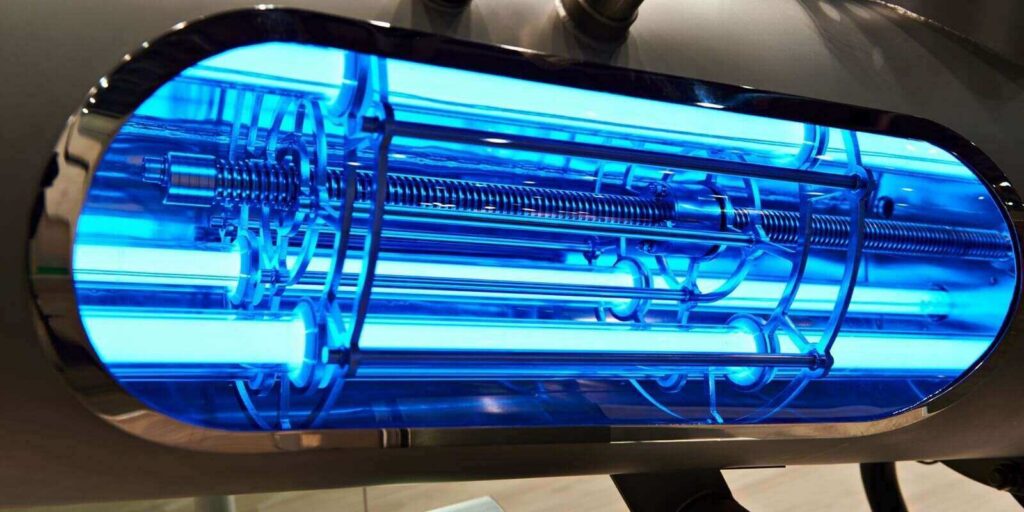
A UV-C bulb inside the treatment chamber emits light at a wavelength of about 254 nanometers. It’s also calibrated to deliver an appropriate amount of light for a given volume of water. At that wavelength, light disrupts the DNA of microbial organisms, not killing them but preventing them from reproducing. The Environmental Protection Agency calls this a deactivation process rather than a removal process, and that distinction from filtration matters.
If your water test also showed elevated turbidity (cloudiness from suspended particles), UV won’t clear it up, and the order of the two processes matters. Cloudiness can block the UV light that’s intended to disinfect the water, rendering the UV bulb ineffective.
In short, cloudy water should be filtered first so the UV bulb can be as effective as possible.
What UV Treatment Addresses, and What It Does Not
A properly sized UV system for well water is effective against a wide range of organisms, including coliform bacteria, E. coli, and the parasites Cryptosporidium and Giardia, along with most viruses found in groundwater. Cryptosporidium is notoriously resistant to chlorine, but UV dosing handles it effectively.
UV doesn’t change your water’s chemistry. It won’t touch dissolved iron, manganese, or PFAS compounds, and it won’t soften hard water or clear sediment. If the results from a water test were positive for these issues alongside bacteria, a more complete filtration system, possibly including UV treatment, may be appropriate.
How UV Compares to Chlorination and Particulate Filtration
The following table compares UV disinfection to the two other most common treatment methods, chlorination and filtration.
| Factor | UV Disinfection | Chlorination | Particulate Filtration |
| Primary Mechanism | Disrupts microbial DNA | Chemical oxidation | Physical particle removal |
| Effective Against | Bacteria, viruses, protozoa | Bacteria and some viruses | Depends on filter pore size |
| Chemical Byproducts | None | Trihalomethanes possible | None |
| Removes Sediment | No | No | Yes |
| Ongoing Maintenance | Annual lamp replacement | Ongoing dosing system | Scheduled filter replacement |
Chlorination adds a chemical oxidizer to the water that handles most bacteria well, but it reacts with organic material to form trihalomethanes. The EPA regulates this byproduct of disinfection in public water systems, but it likely isn’t monitored in a private well.
Particulate filtration handles sediment but does nothing for organisms small enough to slip through the filter’s pore size.
The Conditions That Affect UV Effectiveness
For a UV water filtration system to work, its light must reach the organisms. Anything suspended in the water that blocks or scatters light reduces the filter’s performance. Turbidity, iron, and manganese all interfere with UV light, and a well that tests positive for them needs filtration ahead of the UV chamber, not instead of it. Skipping that step is the most common reason a UV water sterilizer underperforms after installation.
UV output also declines as a bulb ages. A lamp that still lights up may deliver only a fraction of its rated dose after a year of continuous use, and annual lamp replacement is standard practice.
When UV Is the Right Choice for a Private Well
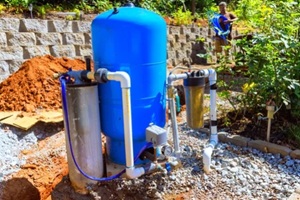
UV makes sense as a primary treatment when a water test confirms E. coli and choliform bacteria or certain protozoan contamination and the water is clear enough for the light to work. If the water has too many particulates, then UV light works well as one layer in a larger system, paired with sediment filtration ahead of it. Look for a system certified to NSF/ANSI Standard 55, an independent certification that distinguishes primary disinfection systems from supplemental ones.
Tri-County Pumps offers a free, on-site water analysis that checks for hardness, iron, and pH. Certified Lab tests for bacteria and other contaminants require the sample to be sent to a laboratory, which will charge a fee based on the tests required and the individual lab. Tri-County Pumps is able to provide an in house bacteria indicating analysis free of charge, but it is not a certified lab test and should not be considered as one. We always recommend a lab test over an indicating analysis, especially when having a reliable result is the homeowners priority.
Discuss UV Light Water Treatment With Tri-County Pumps
Knowing what UV addresses and what it doesn’t is important to solving your challenges as cost-effectively as possible. Tri-County Pumps has been family-owned and operated since 1991, proudly serving our communities in Maryland, Virginia, and West Virginia.
If you have a water test in hand and want a straight answer about whether UV treatment, particulate filtration, or a combined system fits your well, call Tri-County Pump Service, Inc., at (301) 882-2776 or contact us online. We’re here when you need us.