Jul 7, 2026 · 7 min read· Summarize in ChatGPT
| In this article: The household signs that point to a water softener that has stopped conditioning water effectively. Plus the two most common mechanical causes behind the failure, and why adding more salt is rarely the answer. |
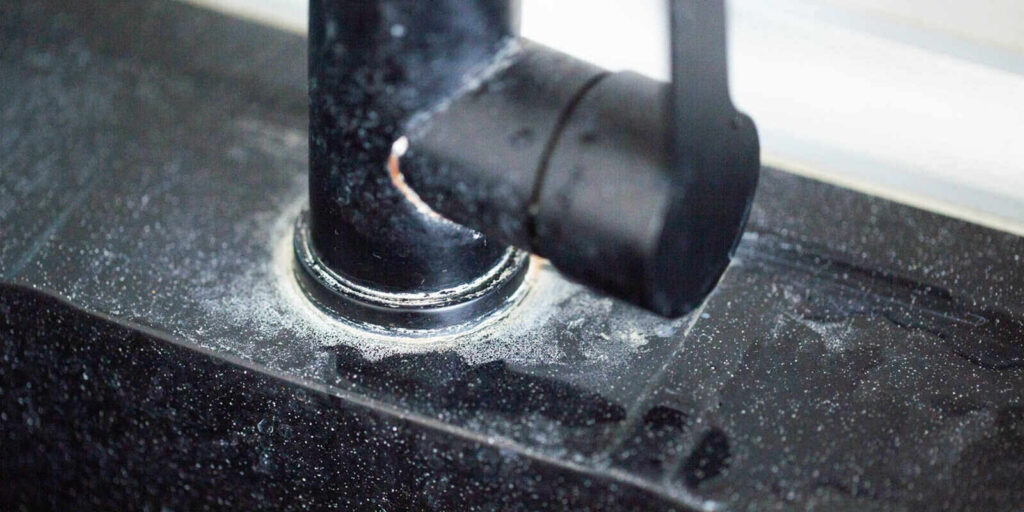
You notice the showerhead has a white crust building up around the spray holes. Your skin feels tight, and your soap isn’t lathering up as easily as it did before. Each of those changes on its own is easy to chalk up to a new product, a seasonal shift, or just one of those household things you shrug off. When they start showing up together, your water softener is worth a closer look.
Changes in water quality are gradual, and most homeowners don’t immediately make the connection. They will attribute the change to other causes before realizing the water softener has failed. By the time the pattern is obvious, hard minerals have been running through your fixtures, appliances, plumbing, and supply lines for weeks or longer.
The Household Signs That Tell You Something Has Changed
How Scale on Your Fixtures and Appliances Points Back to the Softener
The white or chalky deposits forming on your faucets, around sink drains, and on the showerhead are calcium and magnesium carbonates. When a softener is working, those minerals are removed from the water before it reaches your fixtures. When it stops, they come through and leave a residue every time water evaporates on a surface.
What most homeowners don’t see is what’s happening inside the appliances. Scale accumulates on the heating elements in your water heater and dishwasher the same way it builds on external surfaces; it’s just out of view.
On a water heater element, even a thin layer of scale acts as insulation. The element has to work harder and run longer to reach the temperature, and that added strain increases energy bills before breaking it down completely.
Why Your Skin and Hair Feel Different When Hard Minerals Return
Hard water leaves a thin mineral film on skin that can feel tight, dry, or itchy after a shower. Hair washed in hard water tends to feel coarser and may look dull because the minerals interfere with how the hair cuticle lies flat.
If those sensations were absent before and have started showing up gradually, it is worth connecting the change to the softener rather than to a new shampoo or seasonal dryness. The timing of when it started is often the clearest indicator. Homeowners who track it frequently find the change lines up with when the salt in the brine tank ran low or was left unattended.
What Soap Performance and Dishwasher Film Are Telling You
Calcium and magnesium ions in hard water bind with soap molecules and form an insoluble residue instead of allowing the soap to lather. You end up using more products to get the same effect, and you still don’t quite get there.
The dishwasher makes this especially visible. Dishes and glassware coming out of a cycle with a white film or spotting are showing you what the water left behind after it evaporated. A softener in good working order removes those minerals before they ever reach the wash cycle. Without it, the residue builds with every load.
The Two Most Common Mechanical Causes Behind Softener Failure
How a Salt Bridge Creates the Appearance of a Full Tank While Starving the System
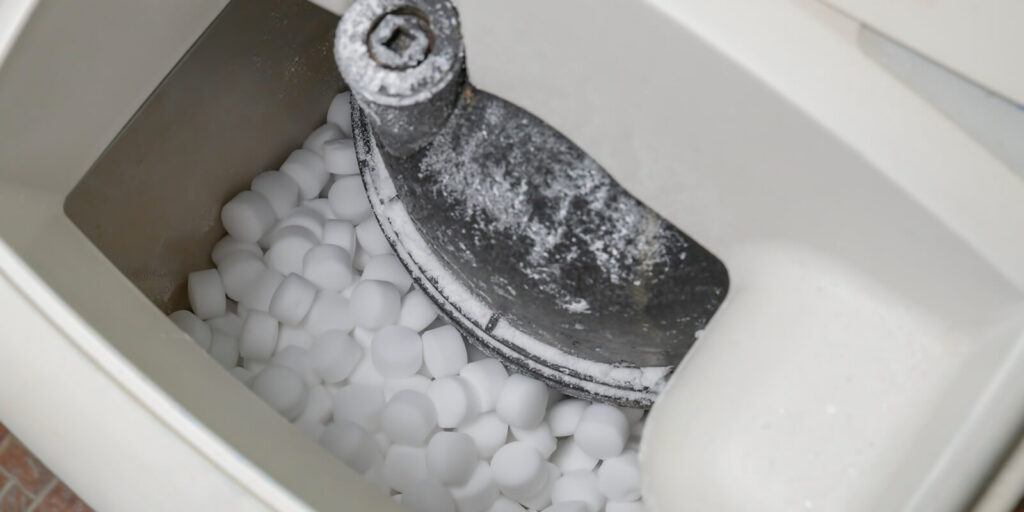
A salt bridge is a hardened crust that forms in the brine tank, typically spanning across the tank above the waterline. It looks like the tank is full of salt because the crust holds its shape, but below it there is an air gap between the salt and the water. The system needs salt to dissolve into the water to create the brine solution that regenerates the resin bed. If the salt never contacts the water, no brine forms, and the resin never gets regenerated.
Salt bridges are more common in humid environments and with certain salt types, particularly pellet salt, in tanks that are topped off too frequently. A technician can identify and resolve a salt bridge quickly once they know to look for one. Most homeowners miss it because the tank appears full, and that appearance can keep the problem hidden for months.
When the Resin Bed Wears Out, and Salt Can No Longer Fix the Problem
The resin bed inside a water softener is what does the conditioning work. It contains thousands of small beads that carry a sodium charge. As hard water passes through, calcium and magnesium ions attach to the beads in exchange for sodium ions; that ion exchange process is what removes hardness from the water.
Over time, the beads break down and lose their capacity to hold an ion charge. The breakdown accelerates when iron or sediment is present in the water supply, both of which are common in well water across Maryland, Virginia, and West Virginia. A resin bed fouled by iron will stop conditioning water regardless of how much salt is in the tank.
When resin is the issue, the brine supply is not where the problem lives. No amount of salt restores a bed that has lost its exchange capacity. Replacing the resin is a job for a water treatment technician, and it restores the system to full function rather than working around the underlying failure.
Why Adding More Salt Rarely Fixes What Actually Went Wrong
Salt is the most visible part of a water softener, so it’s the first thing homeowners check and add when something seems off. Salt only addresses one possible cause of failure, though, and not the most common one.
- Adding more salt on top of a salt bridge makes the bridge harder to detect without making the system any more functional.
- If the resin bed is degraded or fouled, no amount of salt restores the exchange capacity.
- A stuck regeneration valve or a cycle timer that’s off schedule won’t respond to a higher brine level either.
In each of those situations, adding salt delays the point at which a homeowner calls for service. The longer untreated water runs through the home unchecked, the more mineral buildup accumulates in appliances and supply lines. What would have been a softener repair can turn into a softener repair plus a water heater service call once the scale has had enough time to do its work.
| What we test during an in-home water check: Tri-County Pump Service, Inc. offers a complimentary in-home water analysis that includes testing for iron, hardness, and pH. Lab-based testing for bacteria, nitrates, PFAS, and other contaminants is available at additional cost when a more complete picture is needed. |
Schedule a Water Treatment Inspection with Tri-County Pumps
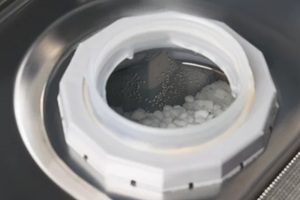
A professional water treatment inspection covers what a homeowner can’t evaluate from the outside. At Tri-County Pump Service, Inc., that means opening the brine tank and checking for salt bridge formation, observing for resin bed degradation or iron fouling, verifying that the regeneration valve cycles on schedule, and running a water hardness test at the tap to confirm whether the system is actually conditioning the supply.
Our team has been working on water softeners and water treatment systems across Maryland, Virginia, and West Virginia since 1991. When our technician walks you through what we found and what it means, that’s the educational approach we’ve built the business on. You leave the visit knowing what your system needs and what the options are.
If any of the signs in this article sound familiar, a water treatment inspection is the right next step. Call Tri-County Pumps at (301) 882-2698, schedule service online, or check our current promotions before you book. We’re here when you need us. Together, Let’s Keep It Flowing®.