
Sep 8, 2026 · 5 min read· Summarize in ChatGPT
Home well water test kits have their place in the full treatment cycle of your system. But the information they provide can be limited, and their quality often isn’t sufficient to make decisions when problems emerge. What they can do is provide supplementary information between full lab panels.
Home test kits and professional water testing services via a certified laboratory serve different purposes. Knowing which one to use will help you build a water treatment plan and maintenance cycle that will help keep your system operating for years.
| In this article: We discuss what a home well water test kit screens for, how it stacks up against certified laboratory analysis, and which one answers the right questions for well owners in Maryland, Virginia, or West Virginia. |
What Home Well Water Test Kits Actually Measure
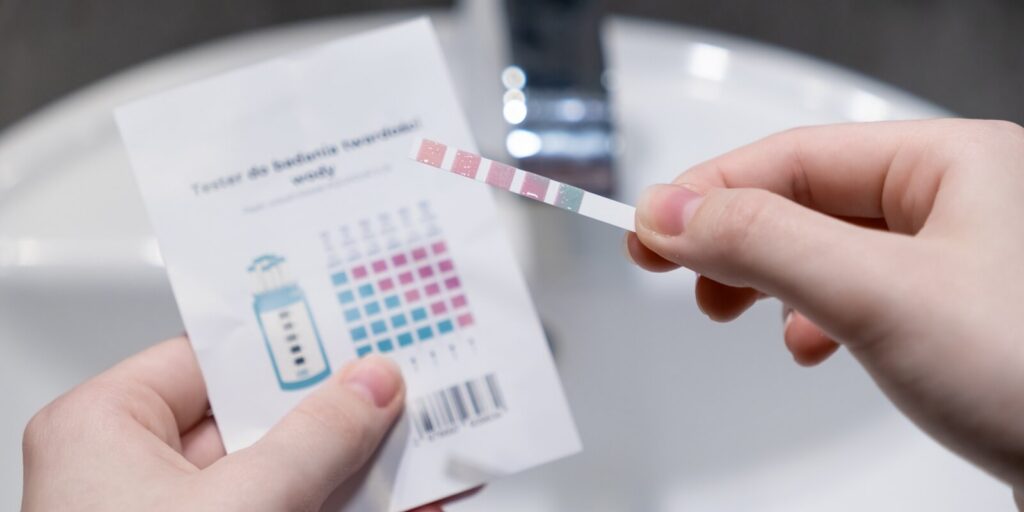
Most consumer well water test kits use colorimetric strips or tablet reagents that change color when exposed to specific compounds. They typically screen for coliform bacteria, pH, hardness, nitrates, and iron. The strip changes shade, and you match it to a printed chart, which tells you whether a parameter falls above or below a set threshold.
No industry-wide standard defines what a home kit must cover. Two well water test kits sitting next to each other on a shelf, priced within a few dollars of each other, can test for entirely different things. And there is no guarantee that what you need can be found on a shelf.
How Home Kit Methods Differ From Certified Lab Analysis
A color-changing strip does not measure concentration. It tells you whether a reading is above or below a threshold set by the manufacturer. But that threshold isn’t always printed clearly on the box. Known as a qualitative or semi-quantitative result, it gives you a rough estimate, not a number you can act on with confidence.
Certified laboratory analysis uses calibrated instruments to produce quantified concentrations for each item you’re looking for, along with a documented detection limit and margin of error. That precision allows plumbing technicians to create treatment plans with confidence.
The sample is also tracked through a chain of custody, a documented record showing exactly how it moved from your tap to the lab’s equipment without being altered. That documentation means a certified result is appropriate for real estate closings or regulatory filings.
What Each Approach Covers
The following table reflects typical coverage for a standard consumer kit against a certified laboratory panel for a private well.
| Factor | Home Test Kit | Certified Lab Analysis |
| Parameters Covered | Limited, varies by kit brand | Full panel including arsenic, radon, and manganese |
| Result Type | Qualitative or semi-quantitative | Quantified concentration with detection limits |
| Bacterial Testing | Coliform indicator screen only | Full coliform and E. coli with counts |
| Inorganic Chemistry | Basic panel showing pH, hardness, iron, nitrates | Full panel including heavy metals and VOCs |
| Documentation | None | Certified result accepted for regulatory or real estate use |
The Centers for Disease Control and Prevention and the U.S. Environmental Protection Agency both recommend annual testing for total coliform bacteria, nitrates, total dissolved solids, and pH, with a state-certified lab handling the sample. Arsenic, radon, and manganese fall outside that basic annual panel and typically call for a one-time baseline test or periodic testing on a longer cycle.
State and federal regulatory agencies also recommend checking well water after flooding, changes to how the land around the well is used, including construction and agriculture, and if you notice a change in how your water looks, smells, or tastes.
Where Home Kits Provide Useful Information
A home test kit that measures for bacteria can be useful as a rapid screen between professional tests. If the area around your wellhead has been exposed to flooding or ground disturbances from industry or agriculture, a quick strip test can tell you if a situation is urgent while you arrange for a certified sample.
Another use of a home kit is to monitor a parameter you already know about. For example, if your water softener is calibrated to a known hardness level, or you are tracking iron on a system already being treated, a strip test gives you an interim read between service visits. It checks a known condition rather than diagnosing an unknown.
When a Certified Lab Analysis Is the More Appropriate Tool
A certified lab analysis is required when you need clear documentation. Real estate transactions and regulatory submissions, for example, depend on a result backed by a lab’s certification.
Home kits don’t measure, at least with meaningful accuracy, arsenic, radon, manganese, lead, or volatile organic compounds. Measuring those requires laboratory instrumentation.
Choose the Right Tool for the Question You Are Asking
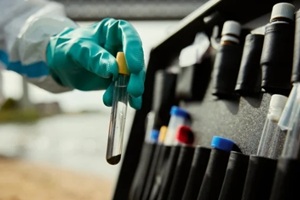
Tri-County Pumps offers free in-home water analysis tests for hardness, iron, and pH. It does not cover bacteria, arsenic, radon, manganese, or other parameters that require lab equipment. When a well owner needs those answers, we collect the water samples for certified laboratory testing.
The question you need answered determines whether a home test kit or a lab analysis is best. Testing hardness is a fair, relatively low-stakes question for a strip test. If you’re worried about something more significant, such as high levels of arsenic or bacterial load, you’ll want results from a certified laboratory.
At Tri-County Pumps, we’ve spent over 30 years helping homeowners in Maryland, Virginia, and West Virginia understand their water quality and how to treat any issues they might have. As a family-owned business, we’ve built our reputation by helping homeowners in our area treat what’s happening with their water today, while providing solutions to prevent issues from happening tomorrow.
If you are searching for well water testing near you, or comparing water testing labs and water testing companies in the Maryland, Virginia, and West Virginia area, call Tri-County Pump Service, Inc., today at (301) 882-2776 or contact us online to schedule a certified laboratory analysis for your well. You will get documented, quantified results that a home well water test kit cannot provide. Let’s Keep It Flowing®.